01. The Challenge
Real estate marketing suffers from a significant “speed-to-listing” bottleneck. Creating high-quality property tour videos typically requires manual asset gathering: downloading user-submitted photos, converting proprietary formats (like Apple’s HEIC), sourcing satellite imagery, generating voiceovers, and manually syncing audio timelines in video editing software.
Our client needed to eliminate this post-production drag. However, early attempts at automation faced critical stability issues. Heavy binary payloads (10MB+ image sets) were causing ECONNRESET memory crashes during metadata logging, and asynchronous race conditions meant the video renderer often triggered before the image assets had fully downloaded, resulting in incomplete outputs.
02. The Process
Phase 1: High-Availability Architecture & Memory Logic
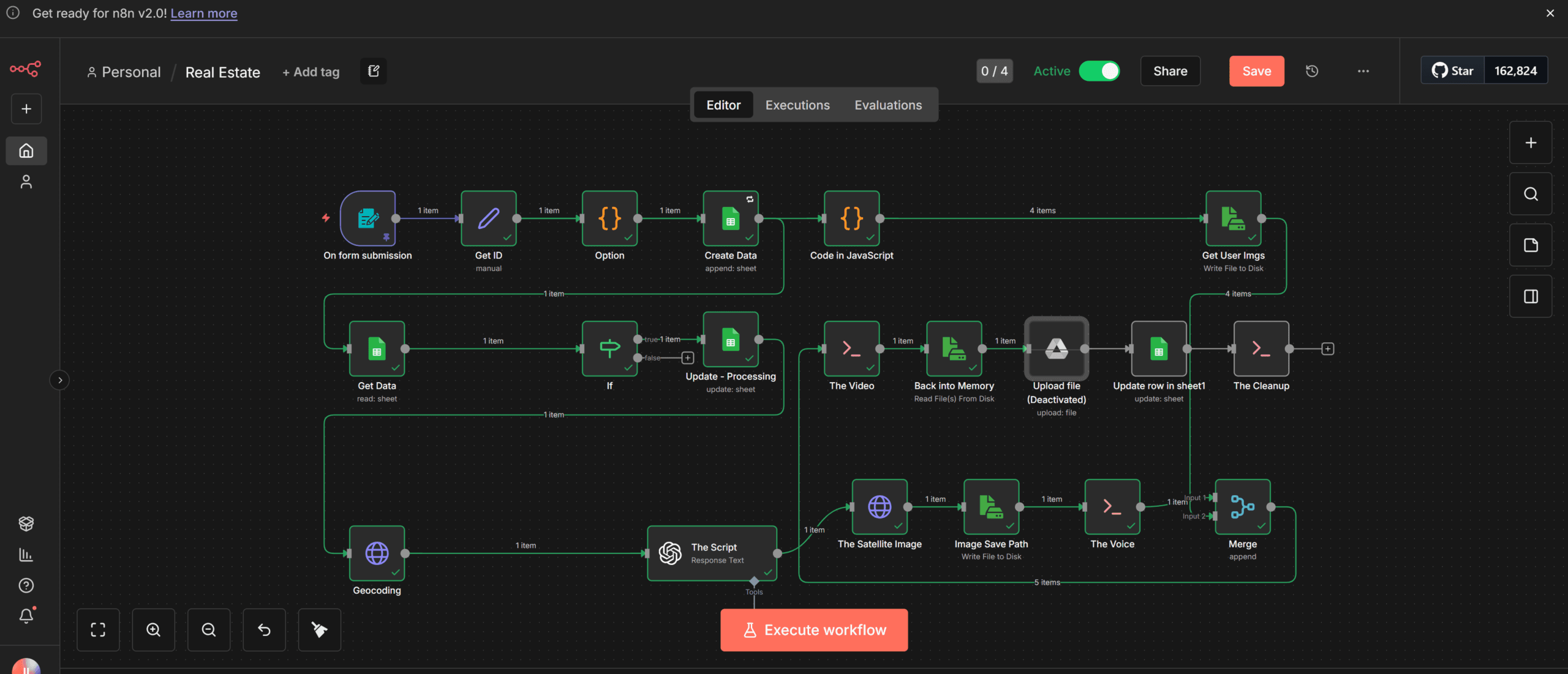
To prevent server crashes, we engineered a “Y-Split” architecture. Instead of passing heavy binary files through every node, the workflow forks immediately upon ingestion. The “Heavy Branch” handles image downloading and file system operations, while the “Light Branch” strips binary data, passing only lightweight JSON payloads to Google Sheets for logging. This eliminated the memory overhead that was terminating the TLS connections.
Phase 2: Dynamic Asset Generation
We integrated the Mapbox API to programmatically generate satellite overlays based on user-submitted addresses. This required a custom geocoding logic layer to parse complex GeoJSON responses, extract strict latitude/longitude coordinates, and inject them into a parameterized static image URL to fetch high-res satellite views dynamically.
Phase 3: The “Sanitizer” Engine & FFmpeg Logic
User-submitted content is unpredictable. We discovered that FFmpeg decoders would crash when processing renamed HEIC files masquerading as JPEGs. We built a custom Bash-based “Sanitizer” script within the n8n execution environment. This script runs a pre-processing cycle that inspects file headers and force-converts all incoming media to standard, compliant JPEGs before the rendering engine touches them.
Phase 4: Synchronous Orchestration
The final hurdle was a race condition where the lightweight logic (Map generation) outpaced the heavy logic (Image downloading). We deployed a “Merge” node configured to a “Wait for Both” state. This acts as a strict traffic controller, ensuring the video rendering process remains locked until both the audio generation and local image storage are 100% complete.
03. The Solution
We delivered a fully autonomous “Input-to-Render” Pipeline. The system acts as a headless video production studio. Agents simply submit a form with an address and photos. The Automated Engine handles the rest: it calculates the optimal duration per slide based on the AI voiceover length, sanitizes the images, overlays the satellite map, renders a 1080p MP4 via FFmpeg, and uploads the final asset to Google Drive—all without a single human click.
04. The Result
The transformation was absolute. What used to take 20-30 minutes of manual editing per listing is now instantaneous. The client achieved a 100% success rate on uploads, regardless of whether the agent uploaded clean JPEGs or raw iPhone HEIC files.